Emotional Dysregulation Treatment: Options That Help
November 2, 2026


Emotional dysregulation is treatable. The strongest-supported options are skills-based therapies such as cognitive behavioral therapy (CBT) and dialectical behavior therapy (DBT), daily regulation skills you practice between sessions, and, when a doctor judges it appropriate, medication. If a brain injury, trauma or cognitive change sits behind the symptoms, the plan should address that too. Below, we walk through what each option involves, when to reach out, and how we support brain-based care here in Meridian, Idaho.
The American Psychiatric Association describes emotional regulation as noticing, understanding and responding to emotions in ways that fit the situation and support well-being. It is not about being positive or calm every hour of the day. It is about recognizing what you feel and choosing how to respond, instead of being run by the feeling.
Emotional dysregulation is what happens when that process breaks down. You may notice:
If this sounds familiar, you are not weak and you are not alone. The same APA page notes that many things can contribute, including biology, life experiences, chronic stress, sleep, substance use and your environment. That matters, because it means there is more than one place to start.
Self-help has a real place, but some situations call for a professional. Cleveland Clinic advises seeking help when emotions are consistently intense or slow to settle, repeatedly cause conflict, interfere with work, school or daily responsibilities, lead to impulsive or risky behavior, or do not improve with self-help strategies.
WebMD adds a few more signals for prompt medical or mental-health evaluation: dysregulation that appears suddenly, frequent outbursts that do not match the situation, and using substances or food to cope.
If you are in crisis or thinking about harming yourself, do not wait for an appointment. In the United States, call 911 or call or text 988 to reach the Suicide & Crisis Lifeline.
A sudden change in mood or temper that follows a fall, a car accident, a sports hit or a diagnosis deserves a medical look. We cover that below.
Most treatment for emotional dysregulation is built around teaching skills. You learn to see the pattern, slow it down and respond differently. Here is how the main options compare.
| Approach | What it focuses on | What the research says |
|---|---|---|
| Cognitive behavioral therapy (CBT) | Spotting and reframing unhelpful thought patterns | Can improve coping skills |
| Dialectical behavior therapy (DBT) | Distress tolerance, emotion regulation, relationships | Uses skills training, problem-solving and validation |
| Mindfulness-based interventions | Staying present with feelings without reacting | Evidence of benefit for emotion regulation |
| Unified Protocol | Shared emotional skills across anxiety and mood problems | Evidence of benefit for emotion regulation |
Cleveland Clinic describes CBT as helping people recognize and reframe negative thought patterns, while DBT teaches skills for regulating emotions, tolerating distress and improving relationships.
One narrative review also found that CBT combined with ITEC produced larger improvements in emotion regulation than CBT alone. The takeaway is encouraging: layered approaches can add to what a single method does.
Researchers writing about what good treatment looks like say it should build modification-focused and acceptance-based skills, along with preparatory skills such as emotional awareness and labeling. In plain terms, you learn to name what you feel first, then to change what you can and make room for what you cannot.
A few questions help narrow the path:
Therapy gives you the framework. Skills give you something to do when your heart is racing at 9 p.m. on a Tuesday. The APA lists practical steps: pause before reacting, acknowledge the emotion, focus on the present moment, take slow deep breaths and reach out to trusted friends and family.
Harvard Health offers a similar sequence for adults: when upsetting emotions arise, take deep, slow breaths, count to 10 or take a walk. Hold off reacting until you feel in control, then think about responding rather than simply reacting.
Here is how that can look as a short routine:
These steps are not a cure, and they are not meant to be perfect. Each time you practice, you are exercising the part of your mind that steers. Over weeks, that exercise tends to make the pause feel more natural.
Emotional flare-ups often land hardest on the people closest to us. If arguments with a partner are part of what you want to change, a guide on emotional regulation for couples offers practical conversation scripts and tools for recognizing emotions and choosing how to respond. It can sit alongside any treatment you pursue.
This is where treatment can look different. Emotional dysregulation is a common aftereffect of brain injury. Irritability, mood swings, tearfulness and a short fuse can come from the injury itself, not from a lack of willpower. Knowing that can lift a lot of guilt.
A few points from federal and academic sources:
If you or someone you love is recovering from a head injury, our guides on mild traumatic brain injury treatment in Meridian, the concussion recovery checklist for adults and why cognitive rest matters after concussion can help you plan the early weeks. When work is the worry, see our staged return-to-work plan after TBI.
If brain fog, memory slips or slowed thinking come with the mood changes, our cognitive dysfunction treatment guide explains how we think about that side of recovery.
Medication is a decision for a physician or psychiatrist who knows your history. For people with a brain injury, one federal brief says SSRIs are first-line treatment for posttraumatic affective dysregulation. It also notes that people with TBI are sensitive to side effects, so treatment should start at a low dose and increase gradually, with regimens generally kept streamlined. Never start, stop or change a medication on your own. Bring your questions to your prescriber.
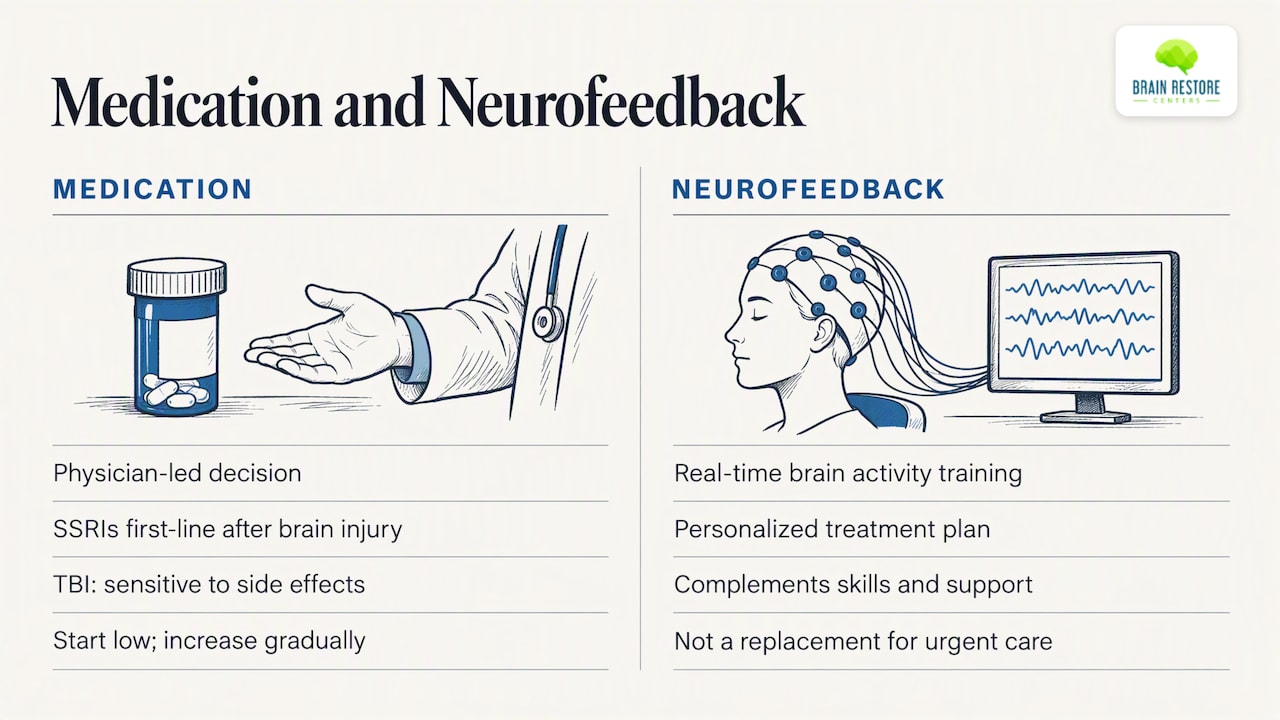
Neurofeedback is a different kind of tool. It is a brain-training approach in which you see your own brain activity in real time and practice shifting it, a bit like exercise for your mind. At our clinic, we use neurofeedback as part of a personalized plan for people dealing with anxiety, low mood, PTSD symptoms, concussion recovery and brain fog. We design each plan around the person, and we see it as a complement to the skills and professional support described above, not a replacement for them or for urgent care.
We meet many people who have been told their emotional struggles are “just stress” or “all in your head.” Often they are neither. When someone has had a concussion, lives with long-term stress, sleeps poorly or feels foggy, the brain is working harder than it should, and emotions are usually the first thing to show it.
That is why we start with understanding, not labels. Our approach is built on a multidisciplinary team and on brain-based therapies such as neurofeedback, low level laser therapy and hyperbaric oxygen therapy, supported by chiropractic care and focused rehab when the body is part of the story. Our goal is to help your brain regulate itself better, so the skills you learn in counseling can actually stick.
We also believe in honesty and in teamwork. Skills training, a trusted counselor, your primary care physician and a clinic like ours can each add something. You deserve a plan that fits you, and you deserve to feel hopeful about it. Recovery is a process, and we are glad to walk through it with you.
Chad
If your emotional changes began after an injury, or if they come with brain fog, memory trouble or lingering fatigue, we can help you understand what your brain needs. Our Brain Restore Program starts with a Brain Health Consultation, where we listen to your history and talk through next steps. From there, your plan may include neurofeedback, laser therapy, hyperbaric oxygen therapy and supportive rehab, built around your goals.
When you are ready, you can book an appointment in Meridian or learn more about all our services on our home page. Many patients also find it useful to read about how functional medicine approaches mental health before their first visit.
You do not need to solve everything at once. Here is a realistic first week:
Small, repeated steps tend to beat heroic one-time efforts. If a day goes badly, that is information, not failure.
There is no single best option for everyone. CBT and DBT are the most widely described therapies, and mindfulness-based approaches and the Unified Protocol also have supporting evidence. The right fit depends on what is driving the symptoms, such as anxiety, ADHD, trauma or a brain injury, so start with an evaluation.
Pause before reacting, take slow deep breaths, and name the emotion you feel. Counting to 10 or going for a walk also helps, according to Harvard Health. Wait until you feel in control before you respond.
Yes. Emotion dysregulation is a common aftereffect of brain injury, and irritability or mood swings can follow even a mild injury. If your mood changed after a head injury, get evaluated by a medical professional, and see our guide to mild traumatic brain injury treatment for what to expect.
Seek help when emotions stay intense, cause repeated conflict, interfere with work or daily life, lead to risky behavior or substance use, or do not improve with self-help. If you are in crisis, call 911 or call or text 988 immediately.
Questions about your next step?
Our Meridian team can help you understand the evaluation process and which care options may fit your needs.
Schedule a ConsultationPrefer to speak with our team? Call 208-639-1397