Why Cognitive Rest Matters After Concussion
June 19, 2026


Cognitive rest after a concussion is defined as the deliberate reduction of mental activity to allow the brain to direct its limited energy toward cellular repair and recovery. Understanding why cognitive rest matters after concussion is the first step toward healing well. When your brain sustains a concussion, a neurochemical cascade depletes the energy reserves your neurons need to repair themselves. Dr. Matthew Grady and other concussion specialists consistently confirm that mental effort during this window competes directly with healing. Consensus guidelines recommend an initial period of physical and cognitive rest before any gradual return to activity.
Your brain undergoes a specific metabolic crisis after a concussion, and that crisis is what makes mental rest so necessary.

At the moment of injury, neurons fire uncontrollably, flooding the brain with neurotransmitters. This surge burns through adenosine triphosphate (ATP), the brain’s primary fuel source. The problem is that blood flow to the brain simultaneously decreases, so less oxygen and glucose arrive just when demand is highest. The result is an energy mismatch that leaves your brain cells vulnerable and struggling to restore normal function.
Here is what that means for you practically:
Cognitive fatigue after concussion is a neuroenergetic mismatch where ATP depletion causes brain crashes after mental overexertion. This is a physiological reality, not a sign of weakness or laziness. When you push through mental tasks too soon, you are literally diverting fuel away from the cells that need it most to repair.
Pro Tip: If you notice your symptoms worsen after 15–20 minutes of focused mental work, that is your brain signaling an energy deficit. Stop the task immediately and rest in a quiet, low-stimulation environment.
The brain also performs vital recovery work during quiet, undirected mental states. Research shows that Default Mode Network engagement facilitates brain restoration. This network, active when you are simply resting without screens or focused tasks, is a key driver of cellular repair. Scrolling your phone or watching television keeps this network suppressed and delays healing.
The answer is more nuanced than “rest until you feel better,” and getting the timing right makes a measurable difference in your recovery.
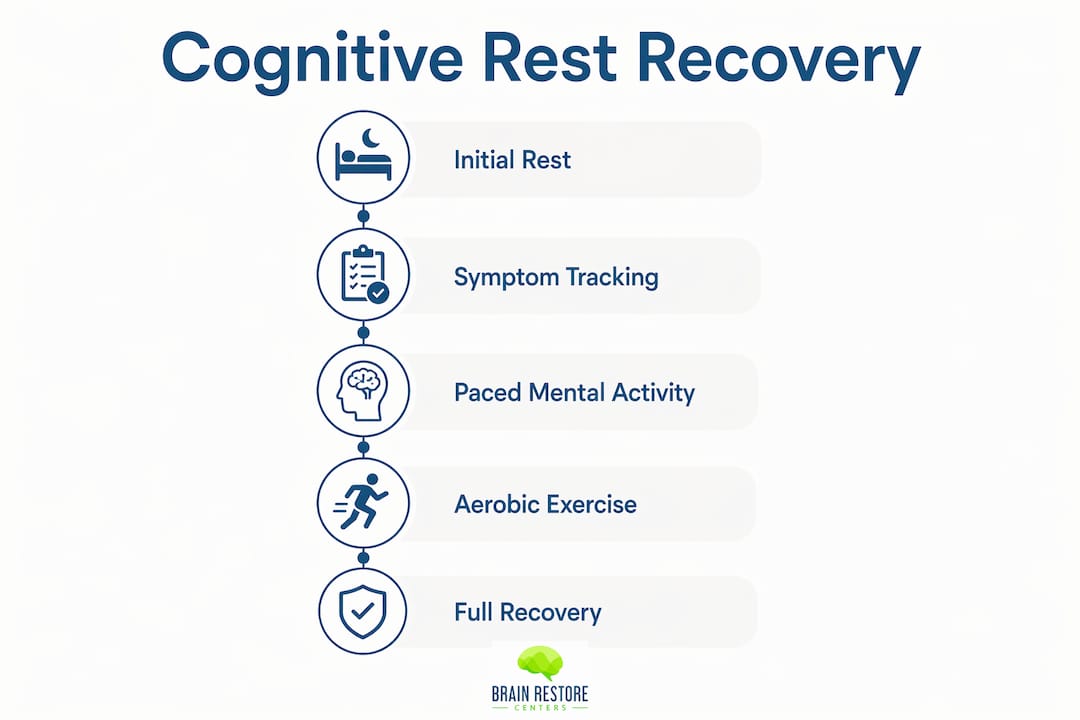
Current clinical standards call for 24–48 hours of brief physical and cognitive rest immediately after a concussion. This initial window is when the metabolic crisis is most acute and when protecting the brain from additional energy demands matters most. Think of it as giving your brain a protected repair window before asking anything of it.
What happens after those first two days is where many people go wrong.
| Approach | Timing | Outcome |
|---|---|---|
| Brief initial rest (24–48 hrs) | Days 1–2 post-injury | Supports metabolic recovery, recommended by clinical guidelines |
| Strict “cocooning” (extended rest) | Beyond day 3 | Delays healing, increases anxiety and depression, causes deconditioning |
| Gradual return to activity | Days 3–7 onward | Improves functional outcomes and mental stamina |
| Symptom-paced active rehab | Week 2 and beyond | Restores processing speed, memory, and emotional regulation |
Strict rest beyond 1–3 days can be detrimental, slowing recovery and increasing psychological symptoms. Extended inactivity also triggers autonomic nervous system disruption. Prolonged bed rest leads to cardiovascular deconditioning that makes physical symptoms worse and harder to reverse.
The clinical term for excessive rest is “cocooning,” and it has real consequences. Extended rest worsens anxiety and depression in concussion patients, which then amplifies symptom persistence. You can end up in a cycle where fear of symptoms keeps you resting, which worsens your mood, which makes symptoms feel more severe.
Pro Tip: Track your symptoms in a simple journal each day. Note what you did, for how long, and how your head felt afterward. This data helps you and your care team identify your personal tolerance threshold and adjust your activity plan with precision.
The goal after the first 48 hours is not total rest. It is paced mental activity, where you do just enough to stimulate recovery without triggering a crash.
Returning to cognitive tasks after a concussion requires a structured approach, not guesswork.
The clinical term for this approach is “symptom-limited” cognitive activity. You engage in a mental task only up to the point where symptoms begin to increase, then stop and rest. This method trains your brain to rebuild stamina gradually without overwhelming its repair capacity.
Here is a practical framework to follow:
Active rehabilitation and pacing are the cornerstones of effective concussion recovery. Measuring recovery by strategy rather than effort is what separates people who heal well from those who struggle for months. You can also check for early warning signs of post-concussion syndrome to know when symptoms are escalating beyond normal recovery.
Pro Tip: Set a timer for your cognitive work sessions. When the timer goes off, stop regardless of how you feel. This prevents the common mistake of pushing past your limit on a “good” day, which often causes a crash the following day.
Aerobic exercise is not the opposite of cognitive rest. Used at the right time, it is one of the most powerful tools for restoring brain function after concussion.
The reason comes down to brain-derived neurotrophic factor, or BDNF. BDNF is a protein that supports the growth and repair of neurons and strengthens the connections between them. Aerobic exercise at 14–21 days post-injury elevates BDNF levels, directly aiding neuroplasticity and improving memory and processing speed recovery. This is why physical therapy after a concussion is often as important as cognitive rest in the early phase.
Safe aerobic activities during this window include brisk walking, light cycling on a stationary bike, and easy swimming. The key is keeping intensity low enough that symptoms do not increase during or after the session. A useful rule is that you should be able to hold a conversation throughout the activity. If you cannot, you are working too hard.
Intense exertion before the 14-day mark carries real risk. High-intensity exercise in the acute phase can re-trigger the metabolic crisis, worsen symptoms, and extend your overall concussion recovery time. You can also learn more about physical therapy’s role in concussion rehabilitation to understand how movement supports brain healing beyond the initial rest phase.
The combination of initial cognitive rest, paced mental reactivation, and timed aerobic exercise creates the conditions your brain needs to restore full function. None of these elements works as well in isolation.
Cognitive rest protects the brain’s energy reserves in the first 48 hours after concussion, but paced mental reactivation and timed aerobic exercise are what drive full recovery.
| Point | Details |
|---|---|
| Initial rest window | Limit cognitive and physical activity for 24–48 hours to protect the brain’s metabolic repair process. |
| Avoid extended cocooning | Strict rest beyond 3 days worsens anxiety, causes deconditioning, and slows overall recovery. |
| Pace mental activity | Use 20–30 minute cognitive sessions with breaks, stopping at the first sign of symptom increase. |
| Screen use delays healing | Phones, social media, and fast-paced video suppress the Default Mode Network needed for brain restoration. |
| Add aerobic exercise at week 2 | Light aerobic activity starting 14–21 days post-injury raises BDNF and supports neuroplasticity. |
The single biggest mistake I see is people treating cognitive rest as an all-or-nothing choice. They either push through symptoms because they feel guilty resting, or they stay in a dark room for two weeks and wonder why they feel worse.
Both extremes cause real harm. The brain needs protection in the first 48 hours. After that, it needs gentle, progressive stimulation to rebuild. Staying in bed beyond day three does not give the brain more time to heal. It deprives it of the low-level input it needs to reorganize and strengthen its networks.
The other thing I want you to understand is that cognitive fatigue is not a character flaw. When your brain crashes after 20 minutes of reading, that is ATP depletion. It is chemistry, not weakness. Accepting that reality makes it easier to pace yourself without frustration or guilt.
What actually works is treating recovery like a training program. You start with what you can tolerate, you track your response, and you add a little more each day. Some days you will go backward. That is normal. The trend over two to three weeks should be toward longer sessions, fewer crashes, and a gradual return to your normal life.
The emotional and social dimensions matter too. Reconnecting with people, even briefly, supports mood and motivation. Isolation amplifies anxiety. Short, low-stimulation social interactions are part of recovery, not a distraction from it.
— Chad
If you are navigating concussion recovery and unsure whether you are pacing yourself correctly, you do not have to figure it out alone.
Brainrestoremeridian in Meridian, Idaho offers personalized concussion care that combines cognitive rest protocols, neurofeedback, and progressive rehabilitation tailored to where you are in your recovery. The team uses qEEG brain mapping to assess how your brain is functioning and builds a plan that moves you from protected rest to full cognitive reactivation at the right pace. Whether you are one week post-injury or still struggling months later, personalized concussion care at Brainrestoremeridian is designed to meet you where you are and get you back to full function.
Cognitive rest is the deliberate reduction of mentally demanding activities, including screen use, reading, and focused problem-solving, to allow the brain to direct energy toward cellular repair after a concussion.
Clinical guidelines recommend 24–48 hours of initial cognitive and physical rest. Strict rest beyond 1–3 days can slow recovery and worsen psychological symptoms, so gradual reactivation should begin early.
No. Screen use, including social media, television, and video games, keeps the brain in a high-stimulation state that suppresses the Default Mode Network and delays the brain’s natural restoration process.
Light aerobic exercise is generally safe to introduce 14–21 days post-injury. Starting too early or at high intensity can re-trigger the metabolic crisis and extend your recovery time.
Worsening headache, brain fog, nausea, irritability, or difficulty concentrating after mental tasks are all signs of a cognitive crash. Reduce session length and increase rest time if these symptoms appear.