
Vestibular Migraine Treatment: Options That Help
October 21, 2026

Vestibular migraine is treatable, even though it is not curable. Most people get relief from a combination of trigger management, preventive medication chosen for their whole health picture, vestibular rehabilitation, and support for the stress, sleep and mood problems that feed attacks. Expert reviews describe it as a condition that can be managed toward long-term remission, and that is the goal we work toward with patients.
If you have been told your dizziness is “just anxiety” or an inner-ear problem that no one can find, you are not alone. This guide walks through what actually works, what the evidence says, and how to build a plan that fits you.
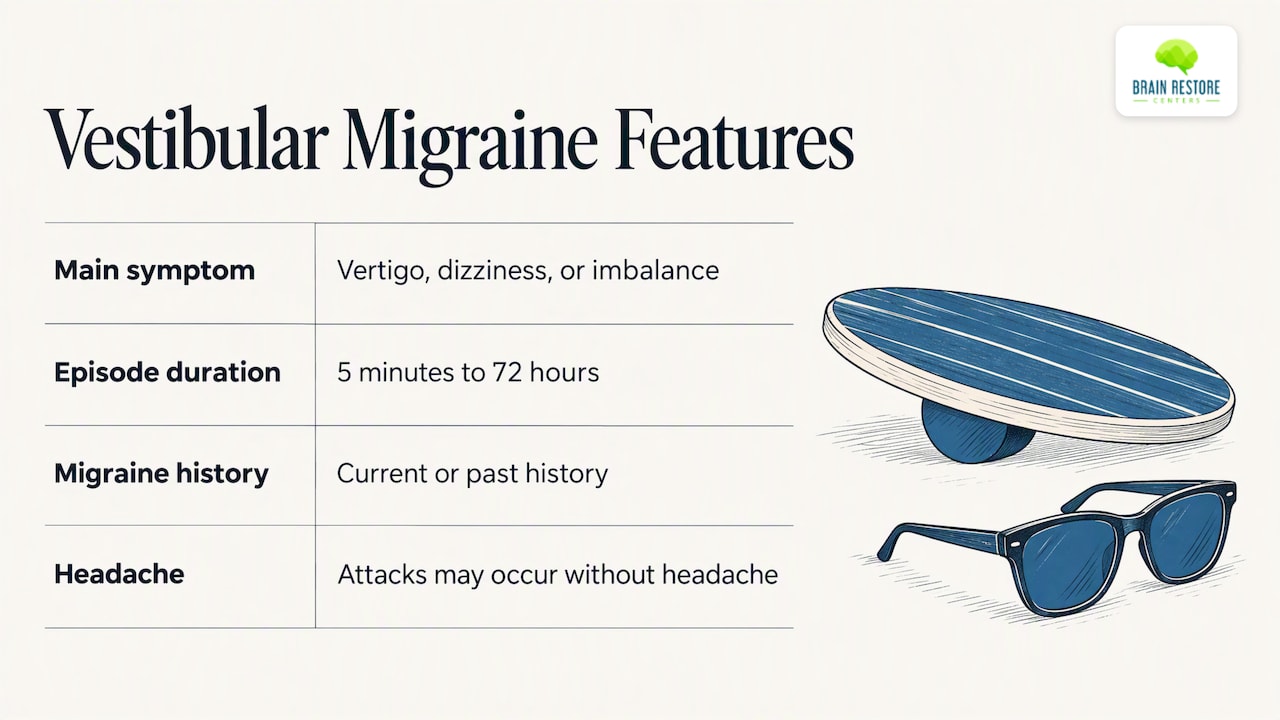
Vestibular migraine (VM) is a form of migraine in which the main symptom is vertigo, dizziness or imbalance rather than head pain. The consensus criteria from the Bárány Society and the International Headache Society call for recurrent vestibular symptoms lasting 5 minutes to 72 hours in someone with a current or past history of migraine.
You may feel spinning, rocking, swaying, or a sense that the floor is moving. Light and sound sensitivity, nausea and brain fog often come along. Some attacks have no headache at all, which is one reason the condition hides in plain sight.
Because rocking or swaying can be mistaken for inner-ear damage or anxiety, many people go years without a clear answer. A practical clinical review of VM treatment notes that the pattern of vertigo combined with migraine features often emerges only over time, which is why recording your symptoms matters so much.
There is no blood test or scan that proves vestibular migraine. Your clinician rules out other causes, such as benign positional vertigo, Meniere’s disease, or a neurological problem, and looks at the pattern.
A simple journal makes that job far easier. For at least a month, write down:
The same review points to this kind of tracking as one of the most effective ways to help a specialist confirm VM. It also gives you your own data on triggers, which turns guesswork into a plan.
Attacks are frequently triggered by stress, sleep disturbances, hormonal changes, and foods such as caffeine or aged cheeses. Not every attack has an obvious trigger, so do not blame yourself when one comes out of nowhere. The American Migraine Foundation also stresses that not all attacks have a trigger, which is why working with a doctor on treatment still matters.
Practical starting points that most people can begin this week:
Medication is a cornerstone of VM care for many people, and your prescriber should lead this part. Current management is largely adapted from standard migraine prevention. Here is how the main categories look.
| Goal | Common options discussed | What to know |
|---|---|---|
| Calming an acute attack | Vestibular suppressants such as antihistamines and antiemetics | Commonly used for acute symptoms, but best kept short-term so they do not slow your brain’s own adjustment |
| Preventing attacks | Beta-blockers (such as propranolol), antiepileptics (such as valproate or topiramate), antidepressants (such as venlafaxine), calcium channel blockers | Chosen based on your other conditions, side-effect profile and goals |
A 2023 network meta-analysis found that valproic acid, propranolol and venlafaxine had the strongest evidence for reducing how often VM episodes occur. Valproic acid showed the greatest decrease in frequency in that analysis. That does not make it right for everyone. Valproate carries serious considerations for people who could become pregnant, for example, so this is a conversation for your physician.
A 2025 practical review of preventive treatment makes the same point: VM needs tailored management rather than a one-size-fits-all prescription.
If you also have lingering concussion symptoms, medication choice gets more delicate. A 2024 review of VM and the disorders it mimics notes that some preventives, topiramate among them, can worsen cognitive symptoms in people with significant cognitive impairment after a concussion. Tell every prescriber about any head injury history and about brain fog, fatigue or memory trouble. Do not stop or change a medication on your own.
Vestibular rehabilitation is a non-drug approach that works by training the brain to compensate for balance deficits. The practical review calls it effective but underused. It also notes that people often stop too early, and that the best results come from consistency and personalized exercises that challenge the system just enough to encourage neuroplasticity without setting off a full migraine attack.
That last part is the art of it. Push too hard and you flare. Stay too gentle and nothing changes. A good program usually includes:
If you want to see what a daily routine can look like, our guide to vestibular exercises matched to your diagnosis breaks it down. If your dizziness began after a head injury, read balance training after concussion and our home oculomotor exercises before you start.
Some people also ask about adding tools such as whole-body vibration to balance work. If that interests you, this explainer on using vibration plates for balance safely covers the basics. Check with your clinician first, since vibration and motion can aggravate vertigo in some people.
The American Migraine Foundation describes how many patients do well with integrative approaches, including biofeedback, Tai Chi (which also trains balance), and diet and lifestyle tracking that builds into an action plan. Having a plan matters emotionally too. Unpredictable attacks can make you hesitant to drive, work or socialize, and a written plan gives some of that confidence back.
A 2023 Cochrane review of lifestyle modifications is discussed in recent VM literature, but the evidence for any single diet or supplement is still limited. Treat these changes as supportive, not as a substitute for a medical evaluation.
VM often travels with anxiety, depression and post-concussion symptoms. Specialists emphasize treating the patient rather than only the condition, because a preventive drug that helps vertigo may worsen fatigue or fog in someone already struggling with both. A review of VM treatment stresses personalized plans for exactly this reason.
Neurofeedback is one brain-based option people ask us about. To be clear, it is not an established treatment for vestibular migraine itself. What the research does show is potential for the conditions that often accompany it: in one study of PTSD patients, neurofeedback was linked to significant improvements in depression and PTSD scores across 17 cases. That is a small sample, so we describe it as promising, not proven. You can read more in our pages on neurofeedback for anxiety and neurofeedback for concussion.
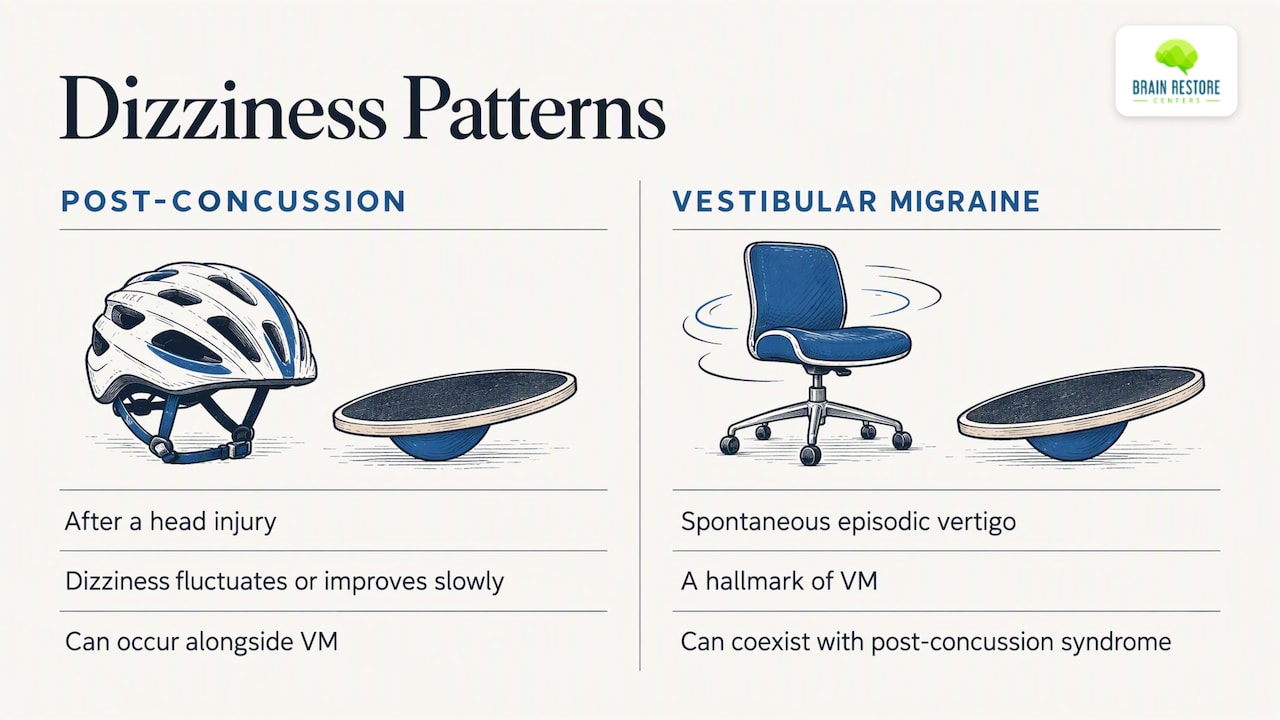
Post-concussion syndrome and VM overlap more than most people expect. As that 2024 review describes, dizziness that fluctuates or improves slowly after a head injury points more toward post-concussion syndrome, while spontaneous, episodic vertigo is a hallmark of VM. You can have both, which creates a double burden.
Early vestibular rehabilitation is recommended to speed recovery in post-traumatic dizziness. Rest also has its place, so see why cognitive rest matters after concussion and our safe exercise after head injury guide for pacing.
VM is not always static. Clinicians describe cases in which episodic attacks progress, and untreated VM can lead to daily, persistent balance problems. That is a reason for hope as much as urgency: earlier rehabilitation and appropriate prevention give your brain the best chance to settle.
We see many people who arrive after months or years of dizziness with no clear explanation. They are tired, a little discouraged, and often told that nothing is wrong. Our view is simple. Dizziness is a brain and body signal, and it deserves a full look: your history, your sleep, your stress load, your neck and posture, your eye movements, your head injury history and your mood.
We do not promise a cure for vestibular migraine, because the research does not support one. What we do believe is that people improve when care is coordinated. Medication decisions belong with your physician or neurologist. Alongside that, we focus on the pieces we can support in our clinic: a careful evaluation, a personalized rehab plan with exercises that challenge you without flaring you, and brain-based support for the anxiety, brain fog and sleep problems that so often keep attacks going.
If you recognize yourself here, take heart. Dizzy days can become less frequent and less frightening, and you can feel steady in your own body again.
— Chad
If you live in the Treasure Valley and your dizziness, brain fog or post-concussion symptoms are getting in the way of daily life, we can help you sort out the next step. Our Brain Restore Program begins with a Brain Health Consultation, and our integrated team brings neurofeedback, laser therapy, functional medicine and progressive rehab together under one plan. You can also read our guides to vertigo treatment in Meridian and balance disorder treatment, or book an appointment directly.
Some patients also ask whether chiropractic care helps migraines. We cover that honestly in chiropractic care for your migraines.
Vertigo with sudden weakness, facial droop, trouble speaking, double vision, a sudden severe headache unlike any you have had, or loss of consciousness needs emergency care. Call 911 rather than waiting to see whether it passes.
During an attack, rest in a dark, quiet place, stay hydrated and avoid sudden head movements. Your doctor may prescribe a short course of a vestibular suppressant or anti-nausea medicine, but these are generally for brief use. Prevention and rehabilitation do the longer work.
There is no single trigger. Stress, poor sleep, hormonal changes and foods such as caffeine or aged cheeses are among the most frequently reported, and your own journal will show your pattern best.
The condition is considered chronic and not curable, but many people reach long-term remission or much milder, less frequent attacks with good management. Results vary, so work with a clinician to track your progress.
Often yes, especially if you feel unsteady between attacks or avoid movement out of fear. A therapist can tailor exercises so they build tolerance without triggering a flare.
Questions about your next step?
Our Meridian team can help you understand the evaluation process and which care options may fit your needs.
Schedule a Brain Health ConsultationPrefer to speak with our team? Call 208-639-1397


