
Poor Focus and Concentration: How Adults Regain Focus
July 31, 2026


Most adult poor focus and concentration is multi-causal. The single best first action is to check three things in order: your sleep quality, your current medications, and whether any urgent symptoms are present. If those three checks come back clear, a structured two-week lifestyle plan resolves a significant portion of cases without a specialist visit.
Quick actions to take right now:
Seek emergency care immediately if you experience any of these:
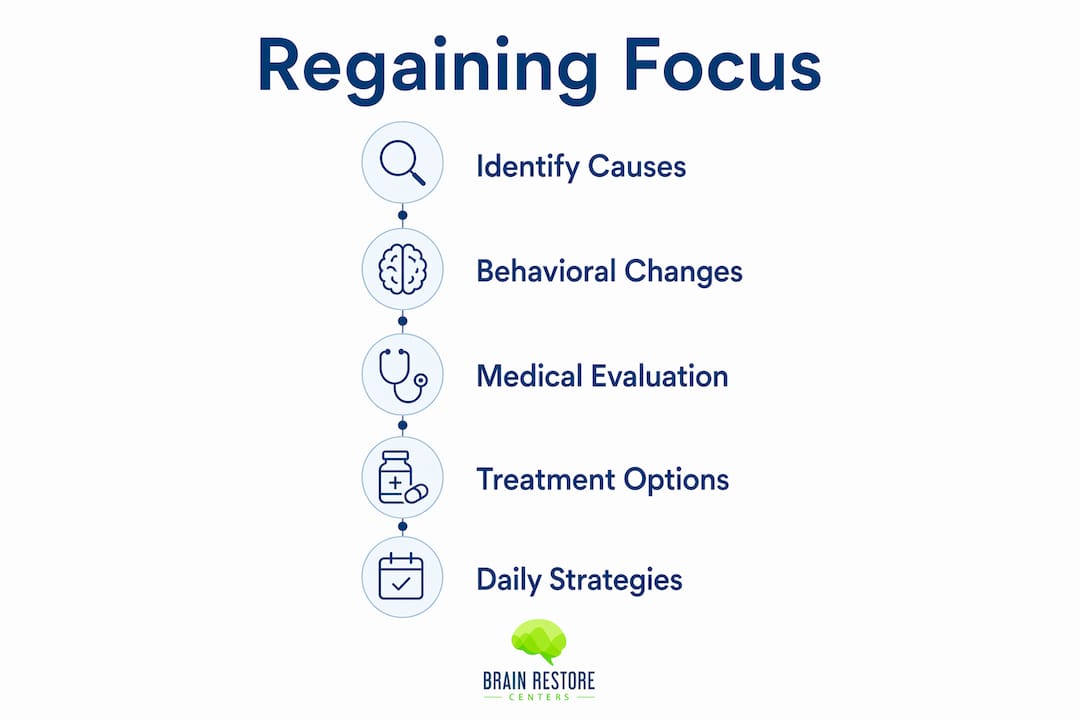
This guide moves from symptoms and causes through clinical evaluation, treatment options, and a two-week starter plan. If you suspect a sleep or medication issue, start with sections 3 and 5. If your symptoms are persistent and unexplained, sections 4 and 8 describe what a clinical evaluation looks like and what advanced in-person options are available.
Difficulty focusing feels different from ordinary distraction, and the distinction matters. A bad night’s sleep causes a rough morning. Clinically relevant lack of concentration shows up across days, weeks, or months and starts affecting your ability to function at work, at home, and in relationships.
Concrete signs worth paying attention to include:
The functional checklist question is this: how many areas of your life are affected? One area (say, reading long documents) points to a specific trigger. Three or more areas, including safety-sensitive tasks like driving, suggests a pattern worth investigating.
Transient low focus, the kind caused by a poor night’s sleep or a stressful week, typically resolves within 24–72 hours once the trigger is removed. Persistent difficulty concentrating that spans several weeks without an obvious cause is the threshold most clinicians use to recommend evaluation.
Pro Tip: Map your focus by time of day for three consecutive days. Note when your concentration is sharpest and when it collapses. A consistent pattern, such as sharp focus in the morning and a hard crash by 2 PM, often points to a specific physiologic cause like blood sugar fluctuation or a medication peak-and-trough effect, rather than a general attention problem.
Difficulty concentrating is rarely caused by a single factor. Most adults who struggle with persistent attention problems have two or more contributors operating at once. Organizing them into four buckets makes it easier to identify which ones apply to you.

Anxiety keeps the brain in a low-grade threat-detection mode, which consumes prefrontal cortex resources that would otherwise support focused attention. Depression typically produces a slower, heavier kind of difficulty focusing, often accompanied by low motivation, slowed thinking, and early-morning worsening. ADHD, which is underdiagnosed in adults, tends to produce lifelong patterns of difficulty with sustained attention, impulsivity, and task initiation rather than a recent change.
Signal patterns: anxiety-related fog often worsens in high-stakes situations; depression-related fog is usually worst in the morning and improves slightly by evening; ADHD-related difficulty is typically consistent across years and settings.
Sleep apnea is one of the most commonly missed causes of daytime cognitive impairment in adults. Untreated, it fragments sleep architecture and reduces oxygen delivery to the brain throughout the night, producing profound daytime fog. Thyroid dysfunction, both hypothyroidism and hyperthyroidism, directly affects the speed and clarity of cognitive processing. Chronic pain, hypertension, diabetes, and metabolic syndrome all carry cognitive side effects that are often attributed to stress rather than the underlying condition.
Signal patterns: sleep apnea fog is worst in the morning and often accompanied by snoring or witnessed apneas; thyroid-related fog usually comes with other systemic symptoms (weight change, temperature sensitivity, hair changes); pain-related impairment tracks closely with pain severity.
Opioids, benzodiazepines, some antidepressants, anticholinergic agents, and certain cardiovascular drugs are among the most common prescription contributors to impaired attention. Over-the-counter antihistamines (diphenhydramine, found in Benadryl and most OTC sleep aids) carry significant anticholinergic load and are frequently overlooked. Alcohol, even in moderate amounts, disrupts sleep architecture and impairs next-day cognition.
Signal patterns: medication-related fog often correlates with dose changes or the addition of a new drug; it tends to be relatively constant throughout the day rather than time-locked to a specific hour.
Chronic sleep deprivation is the most reversible cause of poor concentration in otherwise healthy adults. Diets high in sugar and saturated fats correlate with poorer cognitive performance, while Mediterranean-style eating patterns support brain health. Sustained multitasking and continuous digital stimuli erode prefrontal cortex function over time. Chronic stress elevates cortisol, which at persistently high levels impairs memory consolidation and narrows attentional bandwidth.
Signal patterns: lifestyle-driven fog usually improves noticeably on weekends or vacations; it worsens during high-stress periods and responds relatively quickly to sleep and exercise changes.
A CDC Behavioral Risk Factor Surveillance System analysis found that self-reported cognitive disability doubled among adults aged 19–39 in one study, pointing to multi-factorial drivers beyond any single diagnosis.
When to treat a cause as potentially urgent: a sudden change in concentration, especially one that developed over hours or days rather than weeks, with any focal neurologic signs (weakness, vision change, speech difficulty), requires same-day emergency evaluation.
A structured clinical evaluation separates the reversible and common causes from the ones that need specialist workup. Knowing what to expect makes the visit more productive.
Step-by-step: what typically happens at a first visit
| Feature | ADHD | Mood/anxiety-related | Medication-related | Sleep-related |
|---|---|---|---|---|
| Onset | Childhood, lifelong | Weeks to months | Correlates with drug change | Gradual or after life change |
| Course | Stable, consistent | Fluctuates with mood | Relatively constant | Worse after poor sleep nights |
| Key co-symptoms | Impulsivity, disorganization | Low mood, worry, fatigue | Sedation, dry mouth, constipation | Snoring, morning headache, daytime sleepiness |
| Objective findings | Neuropsych testing, rating scales | PHQ-9/GAD-7 scores | Medication reconciliation | Sleep study, oxygen saturation |
| First-line workup | ADHD rating scales, history | Mood screening, labs | Drug review | Sleep study, TSH |
Screening questionnaires like the Adult ADHD Self-Report Scale (ASRS) or the Conners’ Adult ADHD Rating Scales measure symptom frequency and functional impact across settings. They are not diagnostic on their own but help clinicians decide whether full neuropsychological testing is warranted. Neuropsychological testing measures processing speed, working memory, sustained attention, and executive function with standardized norms.
When to ask for a referral: request one if your primary care clinician suspects ADHD (to psychiatry or neuropsychology), if sleep apnea is confirmed (to sleep medicine), if symptoms are sudden or focal (to neurology), or if multiple causes are present and first-line treatments have not worked (to a multidisciplinary clinic). Understanding functional neurology can help you frame these conversations with your clinician.
Treatment works best when it targets the underlying cause. The checklist below maps common causes to their most effective interventions.
Sleep-related impairment
Medical causes
Mental health treatments
ADHD-specific treatments
Lifestyle strategies
Safety callouts: never adjust or stop a prescription medication without your prescriber’s guidance. Stimulant medications require monitoring for cardiovascular effects. Benzodiazepine tapering should always be supervised.
Pro Tip: Combining behavioral training with medical management consistently outperforms either approach alone. If you start a medication for ADHD or depression, pair it immediately with a structured behavioral strategy, such as time-blocking or a daily focus log, so that the medication’s window of effectiveness is being used actively rather than passively.
Aerobic exercise of even 10 minutes increases blood flow to the prefrontal cortex, making movement one of the fastest-acting, lowest-cost concentration tools available.
The two-week plan below tests whether modifiable factors are driving your difficulty focusing. It requires no equipment and no prescription.

Days 1–3: baseline and environment
Days 4–7: work rhythm and nutrition
Days 8–14: build and measure
| Time | Activity |
|---|---|
| — | Fixed wake, 5 min sunlight exposure |
| — | Protein-forward breakfast, no phone |
| — | First 25-min focused work block |
| 8:25 AM | 5-min break, stand and move |
| — | Second 25-min block |
| — | 10-min walk |
| — | Lunch away from screen |
| — | Hardest cognitive task of the day |
| — | Second movement break |
| — | Screens off, wind-down routine |
Clinical psychologist Lydia Cho emphasizes training attention with brief, repeatable exercises and graded practice to lengthen focus capacity over time. The breath-counting exercise in step 8 is exactly this kind of graded practice: it is short, measurable, and progressively harder as your attention improves.
For readers who want a structured mindfulness approach alongside this plan, a step-by-step mindfulness guide can complement the daily breathing exercises above.
Pro Tip: Track three objective markers, not subjective feelings. “I felt more focused today” is too vague to act on. Instead, log: (1) how many uninterrupted minutes you sustained before your attention broke, (2) how many times you had to reread a passage, and (3) how many tasks you completed versus started. These numbers tell you whether the plan is working within a week.
Knowing when to act, and how urgently, prevents both under-treatment and unnecessary anxiety.
Medical evaluation is recommended when concentration problems persist despite lifestyle changes, interfere with daily functioning, or are accompanied by warning signs. Specifically, schedule a visit if:
A detailed symptom log improves diagnostic clarity and reduces unnecessary testing. Bring:
At the first visit, expect a focused history, a medication review, mood and sleep screening questionnaires, and a basic lab order. Most clinicians will have preliminary results and a working plan within one to two follow-up visits.
For adults whose difficulty concentrating persists after first-line measures, or who have complex multi-factorial presentations, multidisciplinary clinic-based therapies offer additional options. These are not replacements for medical evaluation; they work best alongside it.
Neurofeedback trains the brain’s electrical activity in real time using EEG sensors. The patient receives moment-to-moment feedback (visual or auditory) when their brainwave patterns shift toward states associated with focused attention. Over a series of sessions, the brain learns to sustain those states more reliably. It functions, in a sense, like exercise for your mind’s attention circuits. Supportive evidence exists for neurofeedback in attention-related disorders, and it is among the better-studied non-pharmacologic options for ADHD and post-concussive cognitive symptoms. Research on TMS therapy suggests that neuromodulation approaches more broadly can produce meaningful improvements in focus and concentration for some patients.
Low-level laser therapy, also called photobiomodulation, applies specific wavelengths of light to stimulate cellular energy production in neural tissue. In brain health applications, it targets areas associated with executive function and stress regulation. Evidence is still emerging for cognitive indications, but early data in post-concussive and neuroinflammatory presentations is promising.
HBOT delivers 100% oxygen at above-atmospheric pressure, increasing dissolved oxygen in plasma and tissue. It is used in multidisciplinary settings for post-concussive syndrome, chronic fatigue presentations, and conditions where neuroinflammation is suspected. Evidence for cognitive benefits in non-hypoxic adults is still developing, and it is most appropriate for complex cases with a clear clinical rationale.
A functional medicine workup goes deeper than standard labs, examining hormonal balance, gut-brain axis markers, inflammatory markers, and nutritional status. For adults whose concentration problems have not responded to standard treatment, this kind of comprehensive functional medicine approach often surfaces contributors that routine primary care visits miss.
Practical considerations: clinic-based therapies like neurofeedback typically require multiple sessions (often 20–40 for attention-related goals). Most are not covered by standard insurance plans and involve out-of-pocket costs. A reputable clinic will integrate these therapies with your existing medical care rather than replacing it.
Pro Tip: Before committing to any advanced therapy program, ask the clinic for a clear description of the assessment process, the proposed treatment rationale specific to your case, and realistic outcome expectations. A clinic that skips the assessment and goes straight to a treatment package is a red flag.
Persistent poor focus and concentration in adults is almost always multi-causal, and the most effective path forward starts with sleep, medications, and a structured symptom log before escalating to specialist care.
| Point | Details |
|---|---|
| Start with three checks | Evaluate sleep quality, review all medications, and rule out urgent neurologic symptoms before anything else. |
| Track episodes for one week | A detailed log of timing, co-symptoms, sleep, and diet markedly improves diagnostic clarity at a clinical visit. |
| Use the two-week starter plan | Structured sleep, 10-minute movement breaks, Pomodoro work blocks, and device hygiene resolve many modifiable cases. |
| Seek care when function is affected | Book a primary-care visit if difficulty concentrating persists beyond three weeks or impairs work, driving, or relationships. |
| Brainrestoremeridian offers advanced options | For persistent or multi-factorial cases, the clinic provides neurofeedback, functional medicine assessment, photobiomodulation, and HBOT in Meridian, Idaho. |
Most people who come in struggling with concentration are not broken. They are overloaded, under-slept, or carrying a physiologic burden that nobody has connected to their cognitive symptoms yet. That is genuinely good news, because most of those causes are treatable.
What I want readers to take away is this: the distress you feel when you cannot focus is real, and it deserves a real investigation, not a shrug and a suggestion to “try meditating.” Small, measurable steps, a consistent sleep window, a medication review, a week of symptom tracking, move the needle more reliably than dramatic overhauls. And when self-care genuinely is not enough, multidisciplinary care that addresses brain function, physical health, and lifestyle together tends to produce better outcomes than any single intervention in isolation. Brainrestoremeridian’s approach of combining neurofeedback, functional medicine, and restorative therapies reflects exactly that kind of coordinated thinking.
If you have worked through the lifestyle steps and still find your concentration affecting your work, your relationships, or your safety, a structured in-person evaluation is the logical next step.
Brainrestoremeridian in Meridian, Idaho, offers a multidisciplinary approach specifically designed for adults with persistent cognitive complaints. Services relevant to concentration problems include neurofeedback (with qEEG brain mapping to identify specific attention-circuit patterns), functional medicine assessment (labs, hormonal and inflammatory markers, nutritional status), photobiomodulation, hyperbaric oxygen therapy, and chiropractic support for musculoskeletal contributors to sleep disruption and pain-related cognitive load. For adults dealing with anxiety-related focus problems, neurofeedback for anxiety relief is one of the clinic’s primary offerings.
To prepare for your first visit, bring your symptom log, your full medication and supplement list, and any recent lab results. The clinic’s team will review these before recommending a care plan. Fees are fee-for-service; the front desk can clarify current costs and whether any services align with your insurance coverage when you call. To schedule an evaluation or ask a question, visit brainrestoremeridian.com or call the clinic directly.
This article provides general health information and is not a substitute for professional medical advice. Confirm any treatment decisions with a qualified clinician who knows your full history.
The sources below are worth bookmarking before your next clinical visit. Printing the most relevant ones and bringing them along can help your clinician understand the framework you are working from.
For readers who want to go deeper on clinical guidelines, the American Academy of Sleep Medicine publishes treatment protocols for sleep apnea and insomnia, and the American Psychiatric Association’s practice guidelines for depression and ADHD are freely accessible online. If your clinician refers you for neuropsychological testing, ask for a written summary of results you can keep for future appointments.