Why 40 HBOT Sessions Matter: Ranges and the Session 20 Checkpoint
September 14, 2026

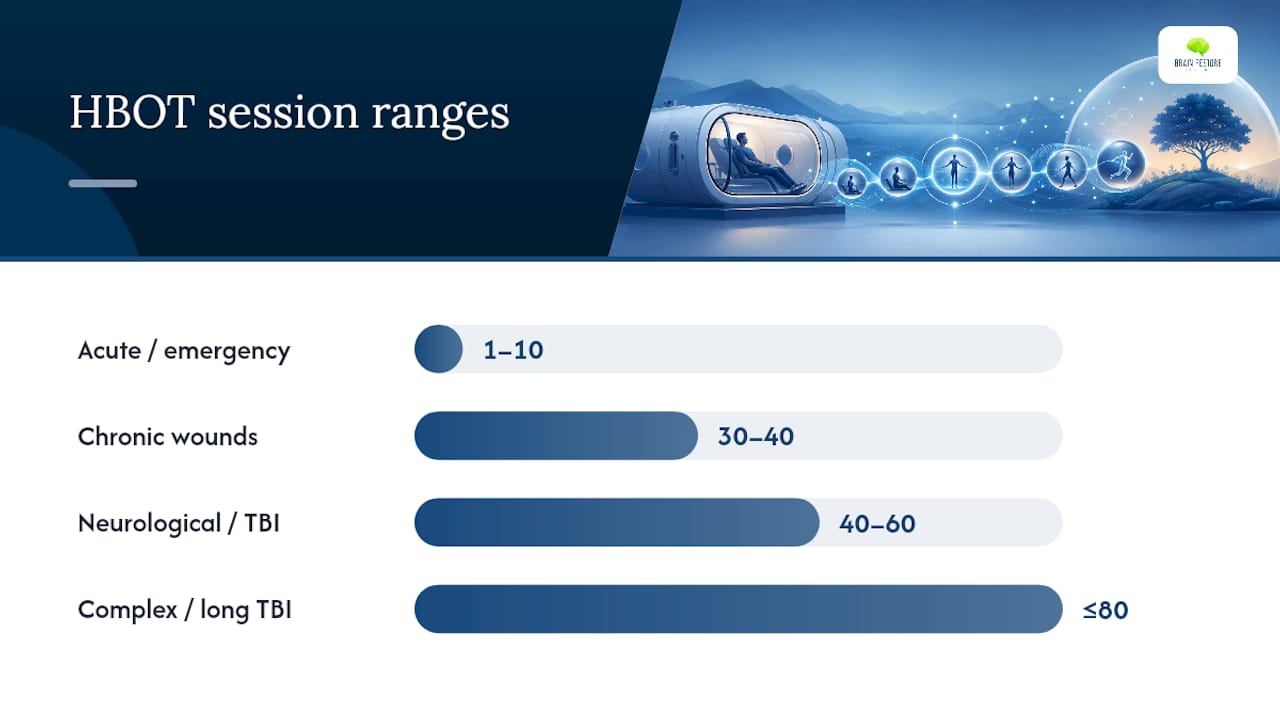
Most people need somewhere between 1 and 60 hyperbaric oxygen therapy sessions, and the exact number comes down entirely to what you’re treating. Acute conditions like carbon monoxide poisoning often resolve in 1 to 10 sessions, while chronic wounds and radiation injury typically need 20 to 40, and neurological recovery protocols frequently run 40 to 60. The 40 session mark has become the standard reevaluation point across many protocols, with most clinics checking progress at session 20 to confirm the plan is working.
TL;DR:
- Acute conditions like carbon monoxide poisoning typically require only 1 to 10 sessions, with most resolving within the first few treatments.
- Chronic wounds and radiation injuries generally need 20 to 40 sessions over 6 to 8 weeks, matching the biological timeline for tissue healing and blood vessel growth.
- Neurological recovery protocols often involve 40 to 60 sessions, with some extending up to 80, due to the longer process of neurovascular remodeling.
- Sessions last 60 to 120 minutes at the treatment pressure, with a typical schedule of five days a week and weekends off to prevent oxygen toxicity.
- Treatment plans are individualized based on initial assessments, progress checkpoints at session 20, and ongoing response, not a fixed number of sessions.
The honest answer: it depends on whether you’re treating an emergency, a slow-healing wound, or a neurological injury. Each category follows a different biological timeline, and clinicians have learned to match session counts to how the body actually repairs itself.
Acute and emergency conditions respond fastest. Decompression sickness and carbon monoxide poisoning are true emergencies where oxygen delivery needs to spike immediately, not build gradually. Mayo Clinic notes that these acute cases often require only 1 to 10 sessions, because the goal is reversing acute tissue damage before it becomes permanent, not rebuilding tissue architecture over weeks.
Chronic wounds and radiation injury need far more time. A diabetic foot ulcer that hasn’t healed with standard wound care typically requires 30 to 40 sessions delivered over 6 to 8 weeks. Radiation-damaged tissue, such as osteoradionecrosis following cancer treatment, follows a similar arc. The reasoning traces back to how new blood vessels actually form. Angiogenesis, the process of growing new capillaries into damaged tissue, unfolds over weeks, not days, and early diabetic foot and radiation trials landed on roughly 30 to 40 sessions because that window matched the biological timeline for new vessel growth.
Neurological recovery and traumatic brain injury protocols run longer still. Many TBI programs use 40 to 60 sessions, and some extend to 80 for more complex or long-standing injuries. The reasoning here is more layered: neurovascular remodeling and reduced neuroinflammation take longer to manifest than wound closure, and research on 40-session TBI protocols point to sustained oxygen exposure as necessary to drive measurable changes in brain tissue. If you’re evaluating a clinic for concussion or brain injury recovery, it’s worth asking specifically about pressure settings and total session count before you commit to a plan.
Off-label and investigational uses sit in murkier territory. Long COVID, stroke recovery, and general wellness or anti-aging protocols see wide variation in practice, from a dozen sessions to 40 or more, but the supporting evidence is considerably thinner than what backs wound care or TBI. If a clinic recommends an extended course for one of these uses, ask what specific outcome measure they’re tracking and why they chose that number.
Here’s how the ranges break down by category:
Plan for a real chunk of your day, not a quick in-and-out appointment. Time actually spent at treatment pressure runs 60 to 120 minutes, with 60 to 90 minutes being the most common window across clinics.
Add pressurization and depressurization, plus check-in and prep, and your total appointment time typically lands between 1.5 and 2.5 hours. Most patients follow a schedule of daily sessions, five days a week, with weekends off. That rest pattern isn’t arbitrary. It gives your body a break from cumulative oxygen exposure while keeping treatment frequent enough to build on itself. Some clinics offer three-times-weekly schedules for patients who can’t manage five days, but that’s a convenience-driven adjustment rather than a clinically proven equivalent to the daily standard.
| Element | Typical Range |
|---|---|
| Time at treatment pressure | 60 to 120 minutes |
| Total appointment time | 1.5 to 2.5 hours |
| Pressurization/depressurization | 5 to 10 minutes each |
| Standard frequency | 5 days/week, weekends off |
| Alternative frequency | 3 days/week (convenience based) |
Pro Tip: Use the restroom before you go in. Once you’re pressurized, you can’t just step out for a break, and depressurizing early to leave the chamber wastes time for you and the next patient’s schedule.
Bring something to read or listen to, and arrange transportation if the session leaves you fatigued afterward. Some patients also find that reviewing basic recovery and pacing strategies between sessions helps them stay consistent through a multi-week course.
Yes, you can overdo hyperbaric oxygen therapy, and clinics build their protocols specifically to prevent that. The main risk is oxygen toxicity, which can affect the lungs or, less commonly, the nervous system when exposure runs too high or too long without adequate rest.
More common side effects are far less alarming. Ear and sinus barotrauma from pressure changes, mild claustrophobia in the chamber, and temporary vision changes (usually mild nearsightedness that resolves after treatment ends) show up regularly. Serious complications are rare when protocols are followed correctly.
Clinics manage the toxicity risk with several standard safeguards:
Pro Tip: If you notice new ear pain, unusual shortness of breath, or vision changes that don’t resolve within a day or two after a session, tell your clinical team immediately. Don’t wait for your next scheduled appointment to mention it.
The 40-session number isn’t arbitrary. It traces back to early clinical trials for diabetic foot ulcers and radiation osteonecrosis, where researchers needed a course long enough to let angiogenesis actually happen. New capillary growth takes weeks to mature, and 30 to 40 sessions consistently matched that biological window closely enough to become the default.
The evidence supporting that number is strongest for wound care and radiation injury, where randomized trials and systematic reviews consistently point to 30 to 40 sessions as both effective and safe. For traumatic brain injury, the picture is newer but building. Some TBI protocols now use 40 to 60 sessions, based on evidence that neurovascular remodeling needs sustained oxygen exposure over an extended course.
The most consistent practice across HBOT protocols isn’t the exact session count. It’s the checkpoint at session 20, where clinicians pull objective measures, transcutaneous oxygen readings, wound photography, or basic neurocognitive testing, and decide whether to continue toward 40 or stop early because the tissue has already responded.
That reevaluation matters more than the total number on paper. A patient who’s healing well by session 20 might finish early. One who needs more time might extend past 40. The number is a planning target, not a rigid contract, and the evidence gets noticeably thinner once you move into anti-aging or general wellness protocols where session counts are often set by convention rather than trial data.
Before starting a course of HBOT, ask your provider these questions to make sure the plan is grounded in evidence rather than guesswork:
That last question matters more than most people expect. Medicare covers HBOT for 14 specific approved conditions, so it’s worth confirming coverage status before you commit to a session count. Understanding what a course of treatment typically costs upfront also helps you plan realistically rather than being surprised partway through.
Your starting number isn’t guessed. A proper assessment establishes a baseline before your first treatment, and that baseline drives everything that follows. Clinicians typically start with a detailed history of your condition’s onset, severity, and any prior treatments, paired with condition-specific testing.
For wounds, that means measuring wound size, depth, and tissue oxygenation with transcutaneous oxygen monitoring. For neurological cases, baseline cognitive testing or imaging gives the clinical team a reference point to compare against later. This baseline isn’t paperwork. It’s the yardstick used at session 20 to determine whether treatment is working.
From there, the clinical team maps your specific diagnosis against the ranges known to work for that condition, adjusts for your overall health and any complicating factors, and sets an initial target, often the low end of the typical range for your condition, with room to extend if early progress supports it. This approach avoids two common mistakes: committing to a rigid 40-session course when 15 might resolve the issue, or stopping early on a slow-healing wound that needed the full course to close.
A thorough initial assessment protects you from both overtreatment and undertreatment, and it gives your care team objective data to point to instead of a generic timeline pulled from a brochure.
Yes, meaningfully. Two patients with the same diagnosis can need very different courses depending on how severe the injury is, how long it’s been present, and what else is going on with their health.
Severity is the biggest driver. A superficial diabetic foot ulcer caught early may resolve faster than a deep, long-standing wound with significant tissue loss, even though both fall under the same general 20 to 40 session range. Chronicity matters too. Wounds or injuries present for months tend to need more sessions than ones caught early, simply because more tissue damage has accumulated.
Age plays a role, though not always in the direction people assume. Older patients don’t automatically need more sessions, but age-related vascular conditions, like reduced circulation from diabetes or peripheral artery disease, can slow the tissue response and extend the course.
Comorbidities are often the deciding factor. Diabetes, smoking, poor circulation, and immune-suppressing conditions all can slow the healing response HBOT is meant to accelerate. A patient managing several of these factors simultaneously may need a longer course, more frequent reevaluation, or a modified pressure protocol compared to an otherwise healthy patient with the same diagnosis. This is exactly why a generic session number pulled from an internet search shouldn’t replace an individualized plan built around your actual health profile.
Patience matters with HBOT, because meaningful change rarely shows up in the first week. Clinicians consistently describe the benefits as cumulative, meaning tissue-level changes build gradually across multiple sessions rather than arriving all at once.
For wound care, the first visible signs, reduced wound size, healthier tissue color at the wound bed, often appear somewhere between sessions 10 and 20. That’s part of why the session-20 checkpoint exists. It’s early enough to catch a nonresponder, but late enough for real biological change to be visible.
For neurological and TBI protocols, timelines stretch further. Cognitive or functional improvements frequently emerge later in the course, sometimes not until well past the halfway point of a 40 to 60 session protocol, because neurovascular remodeling is a slower process than wound closure. Patients pursuing HBOT for brain health and mental health support should expect a longer runway before noticing consistent change, and shouldn’t read a quiet first two weeks as a sign the treatment isn’t working.
Discontinuing early because results feel slow is one of the most common reasons a course underdelivers. The physiology simply needs the time it needs, and stopping at session 12 of a planned 40 session TBI protocol rarely gives the treatment a fair chance to show what it can do.
For most acute conditions, once the prescribed course finishes and objective measures confirm resolution, no ongoing sessions are needed. A closed wound stays closed. Resolved carbon monoxide poisoning doesn’t require touch-ups.
Chronic and neurological cases are different. Some patients benefit from periodic maintenance sessions, spaced weeks or months apart, especially if the underlying condition (like a chronic circulatory issue or a long-standing neurological injury) carries ongoing risk of regression. There’s no universal maintenance schedule here. It depends entirely on how your body responded to the initial course and what your clinical team observes at follow-up checks.
The best approach is asking your provider directly, at the end of your initial course, whether your specific outcome pattern suggests you’re a candidate for maintenance sessions or whether you’re done. That answer should be based on your actual measured progress, not a blanket policy applied to every patient regardless of how they responded.
Some clinics build HBOT plans around a specific diagnosis rather than a one-size number pulled from a chart. This approach means starting with a real baseline assessment, setting an initial target within the evidence-based range for the condition, and checking progress at the session-20 mark before committing to the full course.
— Chad
If you’re dealing with a chronic wound that hasn’t responded to standard care, persistent post-concussion symptoms, or another condition where hyperbaric oxygen therapy has shown promise, the next real step is an in-person evaluation, not another hour of searching for a magic number online. Some clinics offer in-person HBOT and build individualized protocols around a specific diagnosis, health history, and response to treatment, with reevaluation built in rather than a fixed course handed to every patient. Most patients plan for daily sessions five days a week with a checkpoint around session 20, so you’ll know early whether the plan is working before committing to the full course. Brain health and cognitive recovery are also important aspects to manage alongside HBOT, it’s also worth exploring how neurofeebdack supports neurodegenerative recovery as a complementary approach. Reach out to schedule a consultation and get a session plan built around your actual condition, not a generic estimate.
This article is general information, not a substitute for advice from a qualified doctor. Consult a qualified healthcare professional about your own circumstances before acting on anything here.
It depends on your condition: acute cases like carbon monoxide poisoning often need only 1 to 10 sessions, chronic wounds and radiation injury typically need 20 to 40, and neurological or TBI protocols often run 40 to 60, sometimes up to 80.
A single session running much beyond 120 minutes at pressure, or a course with no rest days, raises the risk of pulmonary or neurological oxygen toxicity, which is why most protocols cap sessions at 60 to 120 minutes with weekends off.
Yes. Excessive pressure, session length, or frequency without rest days can lead to oxygen toxicity, which is why clinics use pressure limits around 1.5 to 3.0 ATA and build weekend breaks into every schedule.
Once a week is far below the frequency used in almost every evidence-backed protocol; standard courses run daily, five days a week, because cumulative, closely spaced exposure is what drives the tissue changes researchers have documented.